
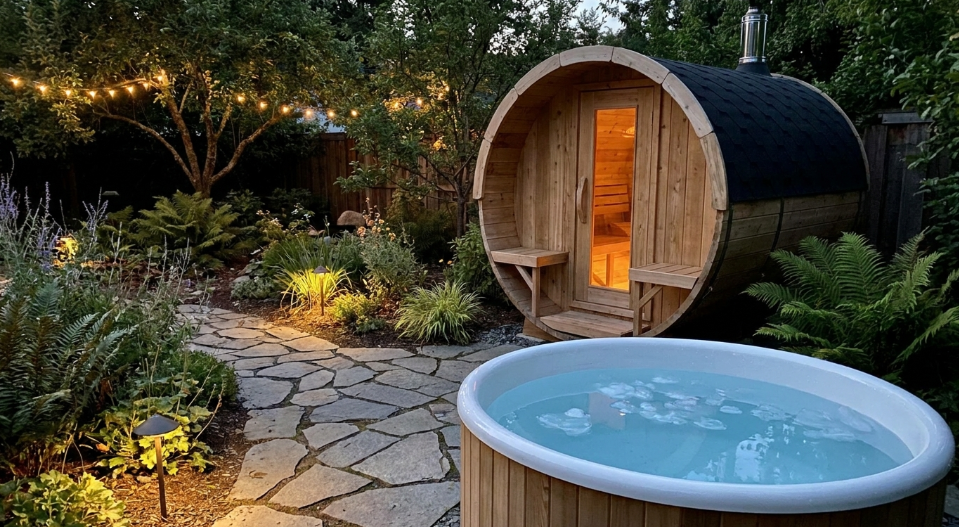
An outdoor sauna used two to four times a week after training can lower resting heart rate faster, ease general muscle tightness, and add a cardiovascular stimulus on top of the one your workout already provided. It will not replace protein, sleep, or a real cooldown, and the strongest supporting evidence is cardiovascular, not muscular. Below are seven specific ways to build outdoor sauna time into a training routine so it actually helps rather than just adding another chore after the gym.
1. Cool down before you walk out to the cabin
Going straight from a hard set or a finishing sprint into full sauna heat stacks two cardiovascular stressors on top of each other before your heart rate has settled. A five to ten minute walk, ideally the walk out to the cabin itself if your yard allows it, brings you down from a hard-training zone first. This matters more outdoors than in a gym locker room sauna, since the walk across a yard in cold weather is itself a small additional stressor your body has to adjust to before it settles into the heat.
2. Match session length to what you actually trained
A heavy lower-body day and an easy spin on the bike do not call for the same sauna dose. After lighter cardio or mobility work, 15 to 20 minutes at a comfortable temperature is plenty. After a demanding strength session, shorter sessions closer to 10 to 12 minutes let you get the cardiovascular benefit without adding excessive fatigue on top of muscles that are already under repair. Building up gradually over a few weeks, rather than starting at 20 minutes on day one, is also how most people avoid dreading the routine after the first month.
3. Use the walk between rounds instead of skipping straight to a shower
If you take two or three rounds in the cabin with breaks between, stepping outside into open air for a few minutes between rounds is a natural fit for an outdoor unit in a way it is not for an indoor cabin tucked into a basement. This is a comfort and pacing choice, not a substitute for a deliberate cold-exposure protocol, and it is worth being clear that this specific pattern has not been isolated as its own variable in the cardiovascular research behind sauna’s mortality associations.
4. Hydrate more than you would for an indoor session
Wind and cold outdoor air dry you out on the walk to and from the cabin in a way indoor sessions do not account for, on top of the sweat losses from training and the sauna itself. Drinking water before, and again after, rather than relying on thirst alone, matters more here than for a purely indoor routine, especially in a dry winter climate where outdoor air moisture is already low.
5. Save the heaviest lifting days for a gap, not an immediate session
Heat exposure immediately following heavy resistance training has been associated in some research with blunted strength and hypertrophy adaptations, likely tied to how heat stress interacts with the same recovery pathways muscle growth depends on. Spacing sauna time a few hours after a max-effort lifting session, or reserving it for lighter training and cardio days instead, sidesteps most of that tradeoff while still getting the cardiovascular benefit on a regular schedule.
6. Dress for the return trip, not just the cabin
An indoor sauna user steps out into a climate-controlled house. An outdoor sauna user steps out into whatever the actual weather is doing, which in a cold climate means going from 170-plus degrees to freezing air in the time it takes to walk back inside. Keeping a robe or a change of dry layers by the door, rather than walking the full distance back in a damp towel, is a small habit that makes winter sessions something you look forward to rather than something you talk yourself out of by February.
7. Build frequency gradually and track it honestly
Two to four sessions a week is a realistic target for most households fitting sauna time around a training schedule, and it is the range most people can sustain long term without it becoming a chore. The strongest cardiovascular associations in the research come from populations using a sauna four to seven times weekly, but that reflects a lifelong cultural habit built over decades, not a number to jump to in the first month. If you are still shopping for a unit built with recovery use in mind, heater recovery time between sessions and interior bench layout both matter more for a household using it several times a week than they do for occasional use, and you can browse the collection at a specialty retailer to compare those details model by model before deciding on size.
What the cardiovascular research actually adds to a recovery routine
A 2018 study in Heart and Vessels measured blood-based markers of cardiovascular function in regular sauna users shortly after a session and found measurable short-term shifts consistent with improved vascular function, a plausible mechanism behind why a sauna session can feel like a genuine reset after training. Longer-term, a large cohort study published in JAMA Internal Medicine associated frequent sauna use with lower rates of fatal cardiovascular events over a multi-decade follow-up, and a 2018 study in Annals of Medicine found that pairing sauna frequency with cardiorespiratory fitness carried a stronger combined association than either factor alone. None of this proves a single post-workout session changes your long-term risk, but it does support treating consistent sauna use as a habit layered on top of training rather than an occasional reward for a hard week.
A quick note on what a sauna is not doing for recovery
It helps to be specific about what heat exposure is not accomplishing, so expectations stay realistic. A sauna session does not directly repair muscle tissue the way protein intake and sleep do, and it will not substitute for a proper cooldown, static stretching, or basic hydration habits after a hard session. What it appears to add, based on the available cardiovascular research, is a secondary heat stimulus layered on top of the training your body already did that day, plus a genuinely useful mental reset for a lot of people who find the routine of sitting still after exercise easier to stick with than a longer stretching sequence alone.
Frequently Asked Questions
How soon after training should you use an outdoor sauna? Within about an hour, after a short walk or stretch to bring your heart rate down first.
Should you skip sauna on heavy lifting days? Not entirely, but spacing it a few hours later, or saving it for lighter days, avoids most of the tradeoff with strength adaptations.
Does cold outdoor air on the walk back undo the recovery benefit? No, a short walk through cold air is not the same as a deliberate cold-immersion protocol and is not a variable the research measures.
How many recovery sauna sessions a week is reasonable? Two to four sessions a week is realistic for most people layering it around training.
References
- Short-term effects of Finnish sauna bathing on blood-based markers of cardiovascular function in non-naive sauna users, Heart and Vessels, 2018
- Association between sauna bathing and fatal cardiovascular and all-cause mortality events, JAMA Internal Medicine, 2015
- Joint associations of sauna bathing and cardiorespiratory fitness on cardiovascular and all-cause mortality risk: a long-term prospective cohort study, Annals of Medicine, 2018


 Is Gestalt Language Processing Evidence-Based?